Features
the highest living standards
Great features
LEARN ABOUT ECO-VILLAGE FEATURES
1. Household farms
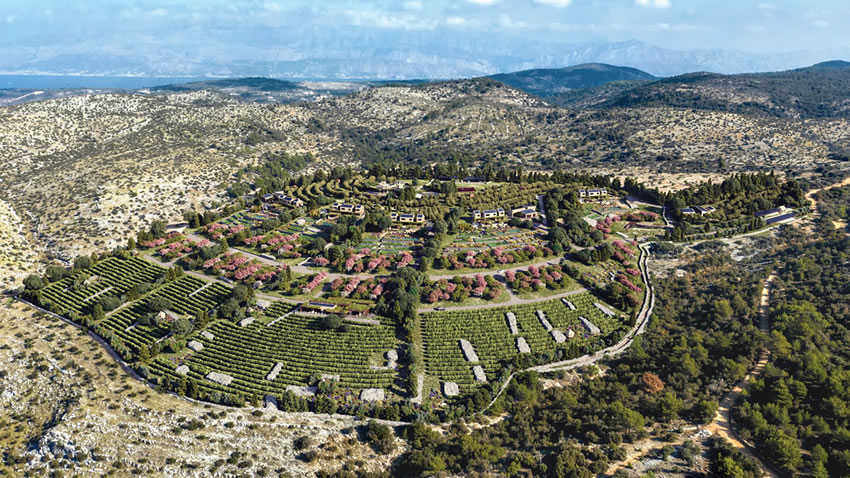
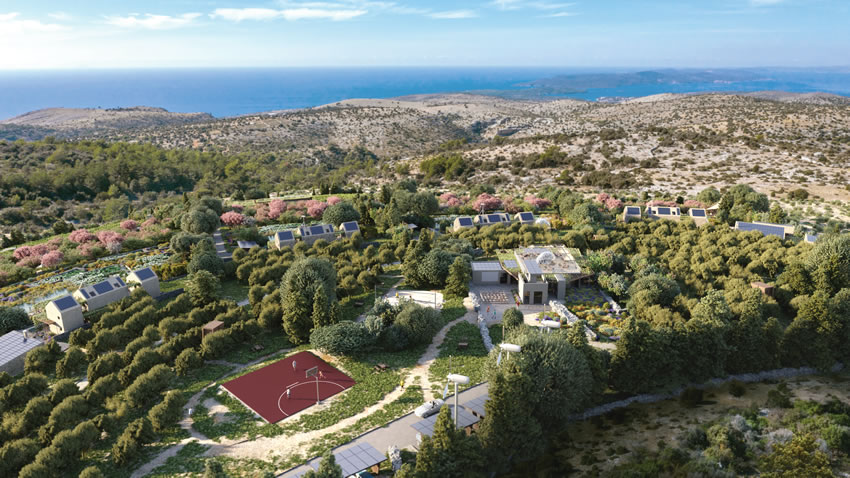
The concept is founded upon the subdivision of the 10Ha area into five household farms of 2Ha each. The farms are meant to interact with the goal of establishing sustainable food producing, consuming and sales, touristic contents and social activity. Nevertheless, each farm will have its own high-class amenities to provide the owners with the highest living standards inside their own household. Each farm will have its production facilities dedicated to specific products: olives and olive products, wine, vinegar and other grape products, domestic animal produce, aromatic herbs and fruit products, restaurant/konoba and social amenities.
2. Roads and buildings
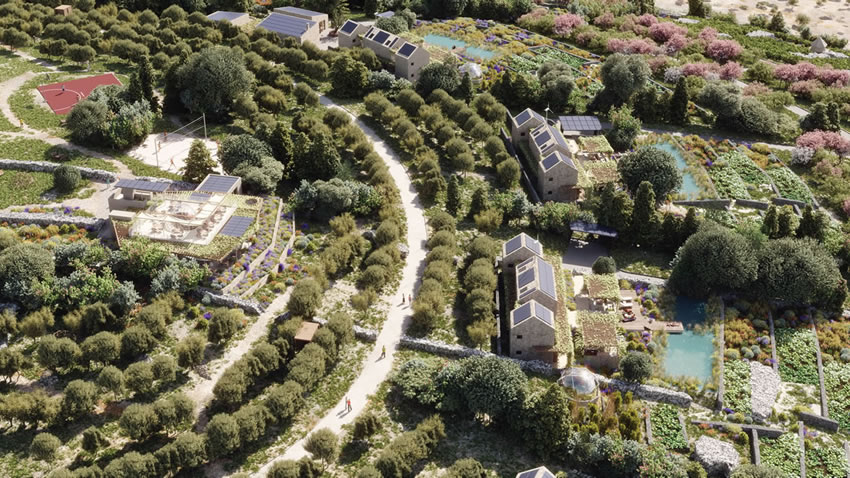
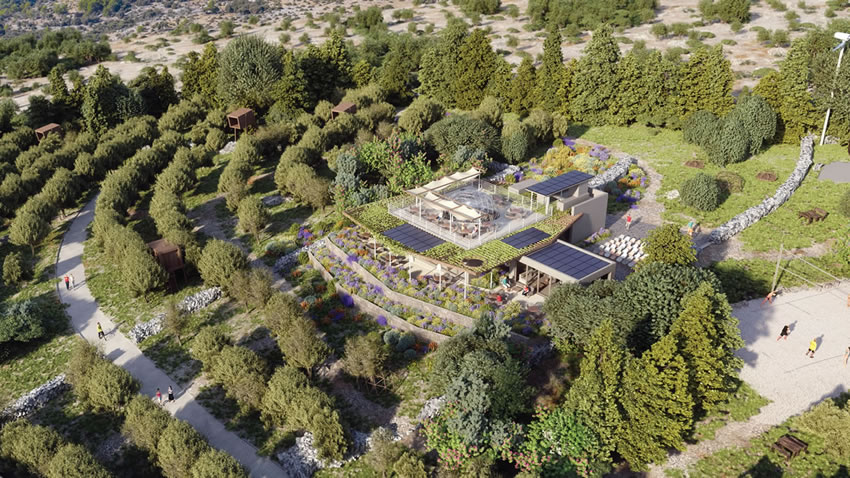
Inside the village, a main road connects the homesteads while the houses and common areas are connected by vehicular footpaths. Another secondary road runs on the top of the ecovillage serving as a connection to the main area with the restaurant/konoba and social-recreation areas as well as a fire road. Agriculture roads are relevant for the connection of various farming and processing facilities. The whole area is crosslinked by pedestrian paths which can serve for recreation, study visits to farms, maintenance etc. Plenty of parking spots are situated at the entrance from where guests can be transferred by simple electric vehicles to not invade the village with too many cars. House owners can access their houses with private cars where parking spaces are secured for them.
3. Sustainable energy and waste management
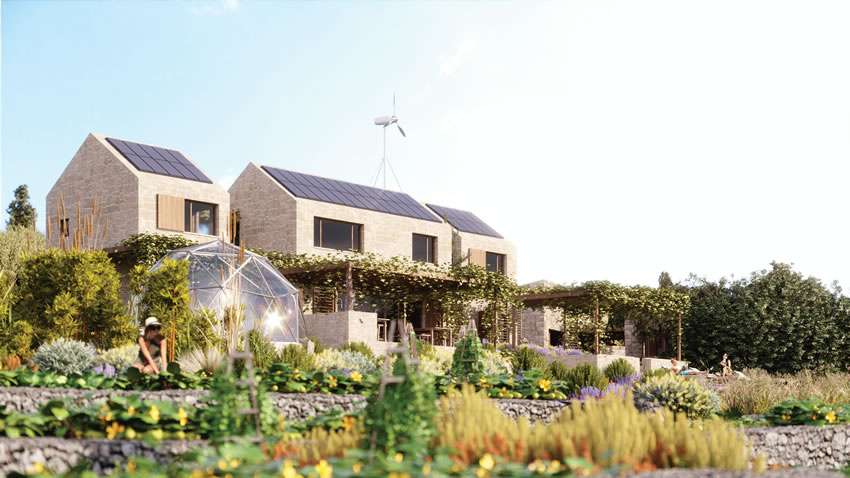
Built from sustainable and natural materials with the highest ecology and economy standards, the houses will feature passive cooling and heating systems. The constructive parts of the houses will mostly be wooden with stone walls, insulation materials will be hemp and straw and where plaster is needed, it will be made of locally accessible lime. The local main roads and access paths to the houses will be made of stabilized gravel. Homes will produce their own electricity by harvesting energy from the sun through solar panels and the whole village will also harvest wind via wind turbines on the highest point of the area. Warm water will be generated from solar collectors and additionally heated by biomass heaters if needed. The homesteads will follow the most modern standards in reducing and recycling waste by separation. To further support low CO2 emission, charging stations powered by solar energy will be established on the parking lots to encourage usage of electric vehicles.
4. Water resources management
The aim is to harvest as much rain as it falls and to store it in underground tanks. The village will have a common large tank while each household will have its own smaller one. The large main tank will be filled by its surrounding alluvial area from where water will be gravity-guided to smaller tanks near the homes. The smaller tanks near the houses will also be filled from the houses’ roofs. Water will also be harvested in natural pools with biological and plant filters. Another applied solution is to recycle waste-water and reuse it for farming or cleaning/washing. By using reed-beds (stone and plant filtering systems) waste-water from the homes can be purified to safely use for food production via irrigation.
5. Integral agriculture and food production system
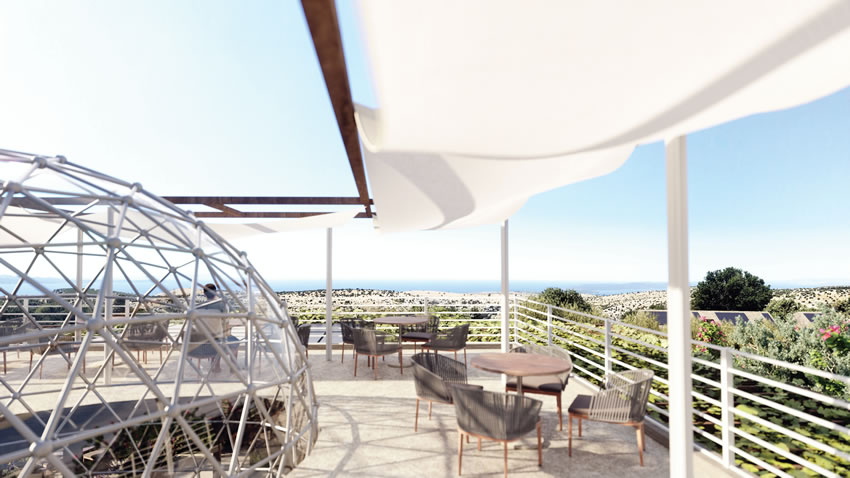
Every homestead will have its role in the local production system. Although the orchards, farming and grazing areas will spread throughout all the homesteads, each homestead will have an annexed farm building for processing the collected food and producing finished products. Each homestead will also have its own dome greenhouse to start vegetable or fruit seedlings or simply to rest inside during colder days.
Olive polyculture orchard
One farm will be dedicated to the production of olives and olive products. The olive orchard will not be a typical one as it will have a variety of other useful fruit trees, shrubs and grasses growing in between with the goal of keeping a healthy eco-system and increasing soil fertility. To avoid soil ploughing, weeding and excess fertilization, rotational grazing of domestic animals will be introduced within the olive polyculture orchard. The olive trees will also be accessible by a small farming vehicle to make the work time and energy efficient.
OLIVE RAFINERY
The annexed farm building will have all the technology necessary for the preservation of olives and olive oil production. An agriculture road accesses the building to make picking and transport of the olives and the final products simple. The building will have a tasting room with the offer of seasoned olives and olive oil. All of the excess material from production will be used as resource and composted to make high quality fertilizer.
Vineyards
The eco-village will have long vineyards all along the low and sunny part of the area so all the views from the homes will reach over the beautiful vines. The vineyards will also be maintained as a polyculture field with varieties of grasses growing in between to increase soil quality from year to year which will strengthen the plants to fight disease and pests. Like in the olive polyculture orchards, the vineyards will also be a part of the rotational grazing with domestic animals’ system.
WINERY
The farm building for wine making and tasting will be situated alongside the vineyards to make the production simpler and the tasting sessions really unique. The building will be equipped with a cellar for wine showcasing and tasting. Guests which arrive for tasting sessions will have the opportunity to walk through the vineyards, try the grapes to taste the distinctive varieties as well as participate in the process of picking and processing the grapes into wine.
Domestic animals
The farm which will be working with animals will hold a herd of sheep as well as one or two donkeys and will be responsible for keeping chickens. It will have a location for bee-hives as well. The farm will produce its own milk, cheese, eggs, honey, meat products etc. It will also serve as a biodiversity pool and manure producing farm which will be very important for the large-scale fruit and vegetable production. The animals will play a very important part in the agroecology of the village as a rotational grazing system will be introduced, which means that the animals will periodically be released into the olive and fruit orchards as well as the vineyards.
ANIMAL STAPLES
The farm building for animals will be equipped with state-of-the-art technology to maintain optimal health of the animals and the products such as advanced cooling systems and sanitation facilities. An important part of this building will be the outdoor area which will produce high quality organic compost from animal manure and organic waste gathered from around the village.
Aromatic and medicinal gardens
Producing various natural medicinal products like tea and cosmetics as well as different seasonings and edible aromatic plants to enhance the food experience in the ecovillage. Most importantly these gardens will grow the plants needed to produce high quality essential oils with medicinal properties such as: myrtle, rosemary, lavender, immortelle and others. Except for the production of quality local cosmetics, natural medicine, tea, etc. the aromatic and medicinal gardens along the homes will spread beautiful scents across the homesteads and even more raise the aesthetics of the surrounding landscape.
AROMATIC AND MEDICINAL PLANT RAFINERY
The farm building to make products with aromatic and medicinal properties will feature all the necessary equipment for drying plants, extracting essential oils etc. At the same time these facilities will be used for fruit preservation and drying as well as making products from fresh fruit like jams, juices, dried fruits and also alcoholic spirits.
Polyculture fruit orchards
A range of fruit trees and bushes will be grown in the eco-village: figs, carob, almonds, cherry, plums, apples, mulberry, blackberry, ... These will be on offer for the fresh fruit market as well as made into preserved products like juice, jams, vinegar, dried fruits etc. in the farm building together with aromatic and medicinal plants.
INTEGRAL FOOD PRODUCTION
The idea of having an integral food production system is to have homesteads cooperate and synergize to provide products of high value. For example, the locally produced cheese can be infused with aromatic plants and served with the local olive oil and wine to make the best degustation experiences. Another example is that the locally produced olive oil, lanolin from sheep and beeswax can be used in combinations with aromatic and medicinal plants to make high quality organic cosmetics.
6. Social areas and amenities + glamping
The very entrance to the village will have a social area with the reception and local produce shop and will be connected with a large common area for everyday meeting and socializing with a boule (boccie) terrain, a fire pit and children's playground.
The eco-village will have its own observatory, restaurant, winery and viewpoint on the highest point of the plot. This space will be open to all of the inhabitants but can also serve as an area to accept guests and tourists and to demonstrate the farming production in the eco-village as well as degustation and study visits. It will also have a large area with enough capacity to allow hosting of bigger parties like weddings, birthdays, open-air movie screenings, acoustic concerts etc. This area is also meant for educational purposes so it will have its own library and conference hall for lectures and workshops.
The outdoor area will feature a recreational zone with a forest polygon/playground, volleyball, basketball, badminton etc. Secluded glamping spots are planned within the eco-village. Each of them will have their own small plot with dwellings of various typology depending on their surroundings. The locations for glamping will each have its own open terrace and possibility to use outdoor showers, kitchens and toilets. Besides locations to put up simple fabric tents, there will be stone “bunje” – a traditional dalmatian small house as well as wooden forest houses for those looking for an even deeper connection to nature.
INDIVIDUAL FARMS
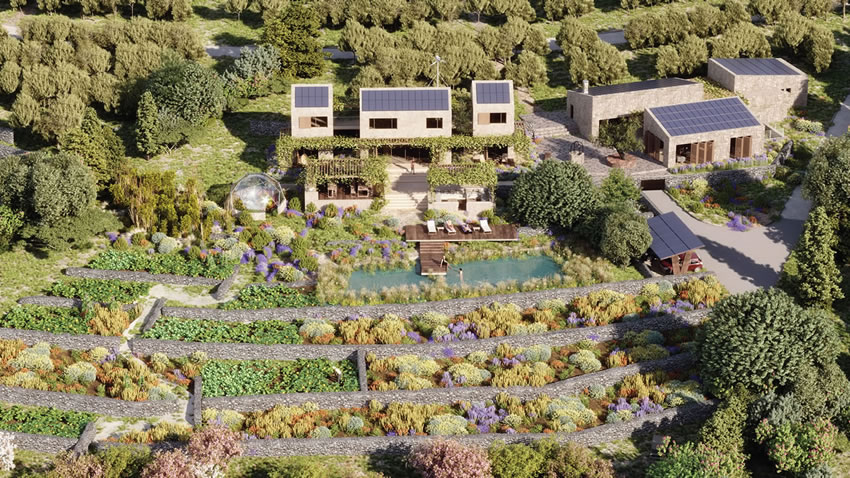
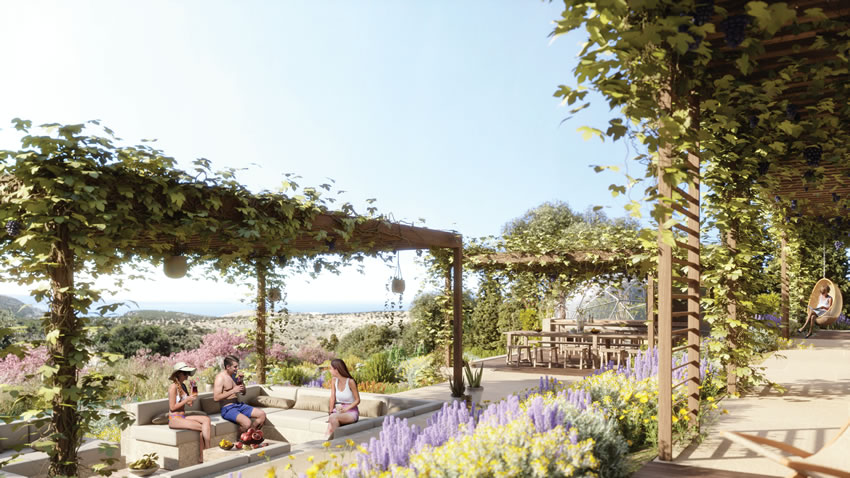
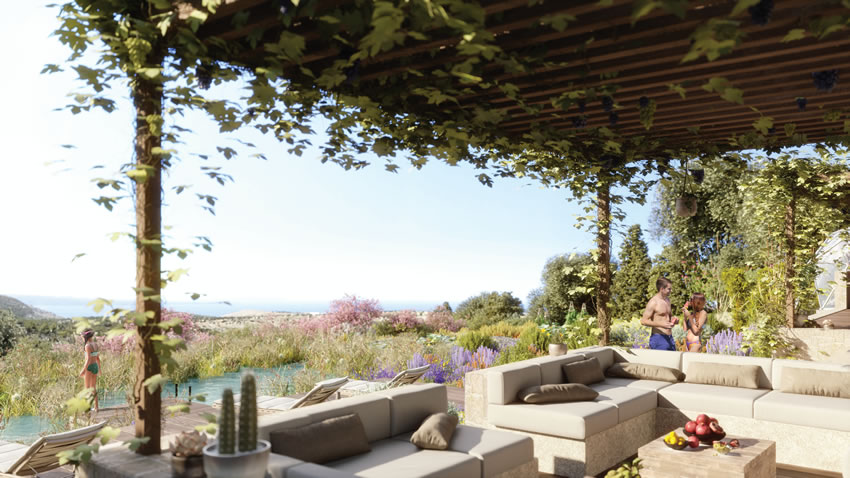
Each farm will feature a 2Ha off-grid homestead with a luxury, low CO2 emission eco-villa with all the commodities of a modern home but made with the use of natural materials, using renewable energy sources and innovative ecological technology solutions. The houses are settled on the terrain in a manner in which they will all have a spectacular sea-view, its own large natural swimming pool, terrace, herbal and vegetable garden and parking accessible from the main road.
Houses will harvest sun and wind energy, use rainwater for washing and will have natural water from a well. Biogas produced from organic waste will be used for cooking to make the homes even more energy efficient. Also, with the use of clever ecological design, the houses will feature passive cooling and heating solutions. They will use no-flush dry toilets of the most modern type, and will recycle grey water from showers and kitchens to add to the sustainability and ecological sense of the homes.
Each house will have its annexed farm building for food processing and storage with a tasting room, product showcase and tavern. These spaces will also serve as common gathering spots with a view and lots of space to host parties and tasting sessions for guests. The five farms will interact to combine their products to achieve different tastes.
Project Story
PHOTO GALLERY